BeginnerCapitalism & Wealth Creation

Pay Yourself First: Illustrated Financial Guide for Farmers

Keep 1 of every 10 bags of harvest BEFORE selling or paying anyone. The foundational rule of wealth from 10 acclaimed books (188.5M copies sold), now illustrated for non-literate farmers.

15 min Foundations Maputo Bridge Capital
Pay Yourself First: Illustrated Financial Guide for Farmers

Course at a Glance

Level
Beginner
Category
Capitalism & Wealth Creation
Learning Track
Foundations
Duration
15 minutes
Instructor
Maputo Bridge Capital
Cost
Free

Pay Yourself First — Illustrated Course for Non-Literate Farmers

Source: Richest Man in Babylon (25M copies), Wealthy Barber (2M), I Will Teach You to Be Rich (2M), Total Money Makeover (10M) Quantum score: 122/100 (highest — foundational principle) Farmer Rule: Keep 1 of every 10 bags of harvest BEFORE selling or paying anyone.

6 ILLUSTRATED MODULES (Zero Text — Pure Visual)

Module 1: Concept Introduction (Big Picture)

[ILLUSTRATION: Farmer standing with 10 bags of grain in a row. An arrow points the FIRST bag into a locked wooden store with a picture of the farmer on it. The other 9 bags have arrows pointing to a market and a house. The locked store has a big green checkmark.]

The picture says: 10 bags harvested. 1 bag saved FIRST (before anything else). 9 bags for living and selling. The bag you save is YOUR payment to yourself.

Module 2: Right Way vs Wrong Way

[ILLUSTRATION: Two farmers side by side. LEFT (red X): Farmer sells ALL 10 bags, pays everyone, has nothing left at end of season — empty hands, sad face. RIGHT (green check): Farmer saves 1 bag FIRST in locked store, sells 9 bags, has grain saved for next season — full store, happy face.]

The picture says: Wrong = sell everything, keep nothing. Right = save 1 bag first, sell the rest.

Module 3: Step-by-Step Action

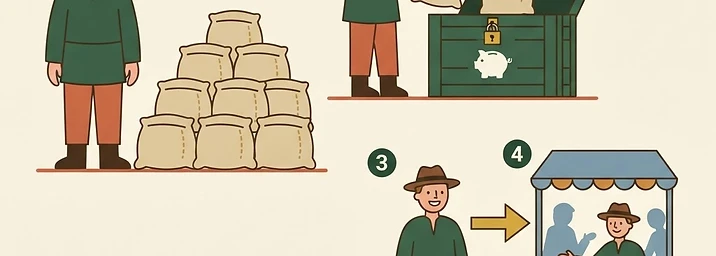
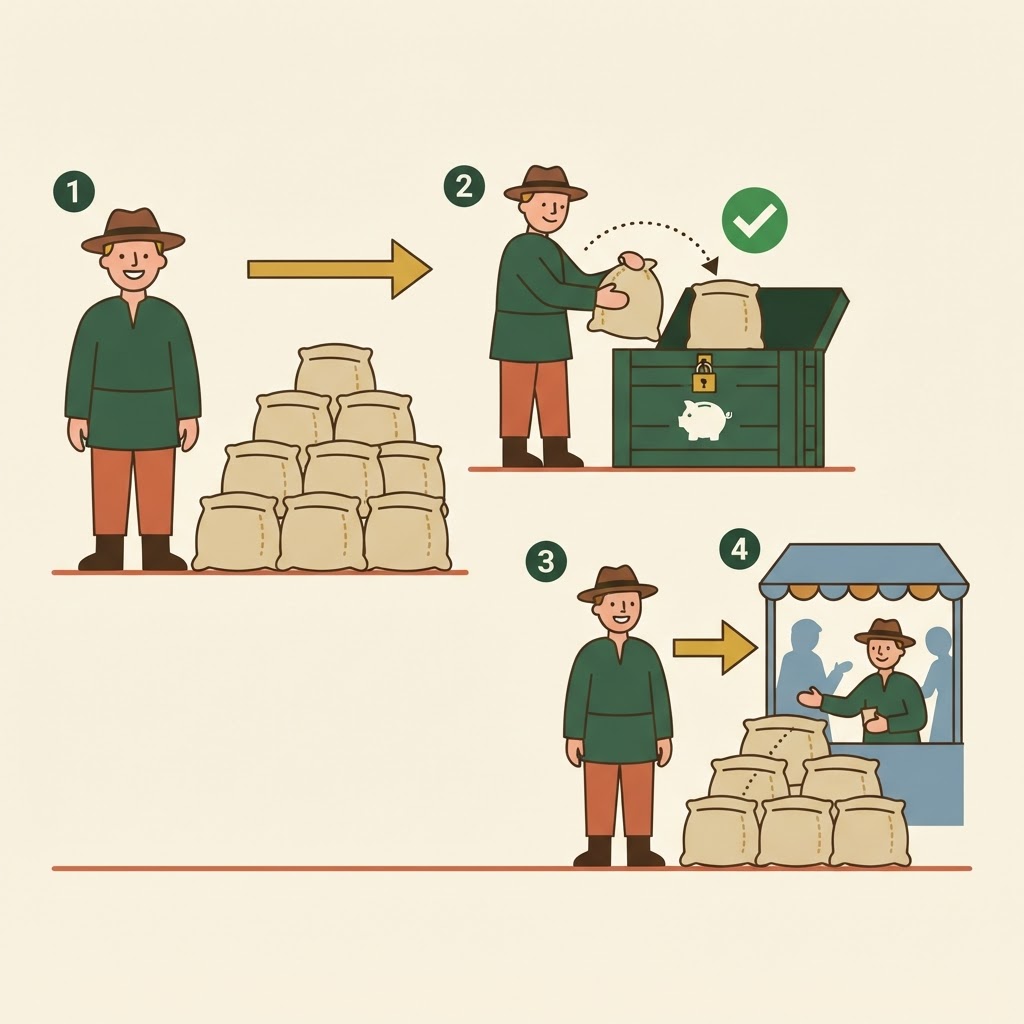
[ILLUSTRATION: 4 panels in sequence. Panel 1: Farmer harvests 10 bags. Panel 2: Farmer takes 1 bag to locked store FIRST. Panel 3: Farmer takes 9 bags to market. Panel 4: At end of season, farmer has 1 saved bag + money from 9 sold bags.]

The picture says: Step 1 = harvest. Step 2 = save 1 bag. Step 3 = sell 9. Step 4 = have savings + income.

Module 4: Real Farm Example

[ILLUSTRATION: Farmer Maria in Zambézia province. She harvested 10 bags of maize. 1 bag (50kg) saved in PICS bag. 9 bags sold at market for 1,800 MZN each = 16,200 MZN ($255). Next season, she used saved seeds to plant without buying new ones — saved 3,000 MZN on seeds.]

The picture says: Maria saved 1 bag. It became free seeds worth 3,000 MZN next season.

Module 5: Common Mistake

[ILLUSTRATION: Farmer pays debts FIRST, buys things SECOND, tries to save LAST. Result: nothing left. Red X. Next to it: same farmer saves FIRST, then pays debts, then buys. Result: savings grow. Green check. The ORDER matters more than the amount.]

The picture says: Save FIRST, not LAST. If you save last, there's nothing left. If you save first, you always have something.

Module 6: Quick Check / Self-Test

[ILLUSTRATION: 3 questions shown as pictures. Q1: Farmer with 10 bags — which bag do you save? (circle the FIRST one). Q2: Farmer with 5 bags — how many to save? (circle 1 — still 10%). Q3: When do you save? (circle the picture of harvest time, not end of season).]

The picture says: Always save the first bag. Always 10%. Always at harvest time.

Visual Guide

Farmer standing with 10 bags of grain in a row. An arrow points the FIRST bag into a locked wooden s
Illustration

Farmer standing with 10 bags of grain in a row. An arrow points the FIRST bag into a locked wooden store with a picture of the farmer on it. The other 9 bags have arrows pointing to a market and a house. The locked store has a big green checkmark.]**

Two farmers side by side. LEFT (red X): Farmer sells ALL 10 bags, pays everyone, has nothing left at
Illustration

Two farmers side by side. LEFT (red X): Farmer sells ALL 10 bags, pays everyone, has nothing left at end of season — empty hands, sad face. RIGHT (green check): Farmer saves 1 bag FIRST in locked store, sells 9 bags, has grain saved for next season — full store, happy face.]**

4 panels in sequence. Panel 1: Farmer harvests 10 bags. Panel 2: Farmer takes 1 bag to locked store
Illustration

4 panels in sequence. Panel 1: Farmer harvests 10 bags. Panel 2: Farmer takes 1 bag to locked store FIRST. Panel 3: Farmer takes 9 bags to market. Panel 4: At end of season, farmer has 1 saved bag + money from 9 sold bags.]**

Farmer Maria in Zambézia province. She harvested 10 bags of maize. 1 bag (50kg) saved in PICS bag. 9
Illustration

Farmer Maria in Zambézia province. She harvested 10 bags of maize. 1 bag (50kg) saved in PICS bag. 9 bags sold at market for 1,800 MZN each = 16,200 MZN ($255). Next season, she used saved seeds to plant without buying new ones — saved 3,000 MZN on seeds.]**

Farmer pays debts FIRST, buys things SECOND, tries to save LAST. Result: nothing left. Red X. Next t
Illustration

Farmer pays debts FIRST, buys things SECOND, tries to save LAST. Result: nothing left. Red X. Next to it: same farmer saves FIRST, then pays debts, then buys. Result: savings grow. Green check. The ORDER matters more than the amount.]**

3 questions shown as pictures. Q1: Farmer with 10 bags — which bag do you save? (circle the FIRST on
Illustration

3 questions shown as pictures. Q1: Farmer with 10 bags — which bag do you save? (circle the FIRST one). Q2: Farmer with 5 bags — how many to save? (circle 1 — still 10%). Q3: When do you save? (circle the picture of harvest time, not end of season).]**

Discussion (0)

Be respectful. Comments are moderated.

No comments yet. Be the first to start the discussion.

Ready to apply what you learned?

Put your knowledge into action — sponsor a farmer or get personalized help.