
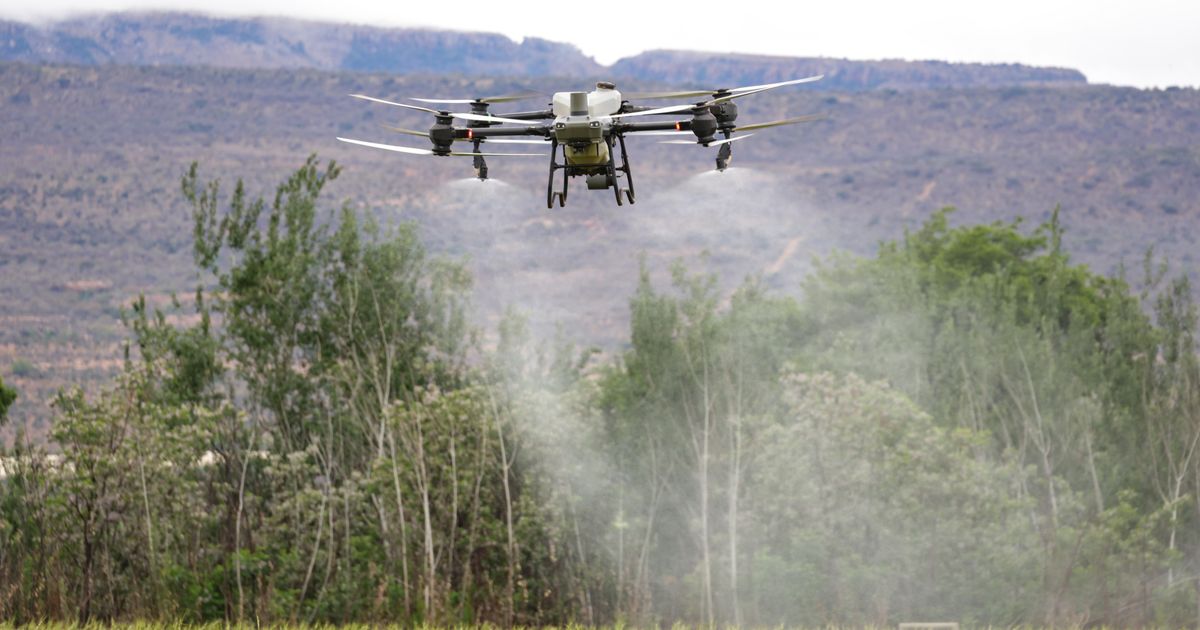
The credit scoring revolution enables us to assess the potential of unbanked smallholder farmers by using satellite imagery to track crop health. By analyzing spectral signatures from space, we can evaluate a farmer's productivity and engagement without needing a traditional financial paper trail.
Rethinking What Creditworthiness Means
Satellite remote sensing has been used in agriculture for decades, mostly for large-scale commercial farming and government crop forecasting. But a quiet revolution has been underway: the resolution, frequency, and affordability of satellite imagery has dropped dramatically, making it possible to assess a 0.5-hectare plot in rural Zambezia province with the same precision previously reserved for Iowa cornfields.
The key metric is NDVI — Normalized Difference Vegetation Index — a measure of crop health derived from how plants reflect near-infrared light. Healthy, well-managed crops reflect differently than stressed or neglected ones. And crop health, it turns out, is a remarkably strong proxy for farmer capability and engagement. Read more about how we utilize these technologies in our analysis of NDVI satellite data as a hidden credit score.
When you combine NDVI data with soil classification maps, rainfall data from weather satellites, and historical yield estimates, you can build a farm-level risk profile that answers the questions a sponsor cares about: Is this farmer active? Are their crops healthy? Do they farm consistently season over season?
The Nature of Wealth
How Asia climbed from poverty to wealth in one lifetime, what more than fifty thinkers teach, and a four-stage plan for Mozambique through agriculture and markets.
PDF ebook, instant download. $5 of every copy buys seed for a farmer.
The Asymmetric Data Advantage
In a country where 81% of the population works in agriculture and 95% of the economy is informal, traditional credit scoring fails almost everyone. Satellite scoring works for almost everyone — because the data is universal. The sun shines on every farm. Satellites see every crop.
This is the vision of what modern technology can offer. At Maputo Bridge Capital, founded by Anselmo Boaventura in Fort Worth, Texas, we work directly with the COJAZ cooperative in Zambezia to support verified smallholder farmers. While we look to the future of technology like AI price prediction engines, our current work focuses on the tangible connection between sponsors and farmers.
Impact on the Smallholder Season
For a smallholder farmer, these technological insights mean better planning and stability. By identifying optimal planting times and monitoring crop health throughout the season, farmers can ensure their inputs—seeds and fertilizer—are used when they are most likely to result in a successful harvest, leading to better yields for the entire community.
Frequently asked questions
What is NDVI? It is the Normalized Difference Vegetation Index, a measure of plant health based on how crops reflect near-infrared light.
Why does satellite imagery help farmers? It allows for objective assessment of crop health and farm productivity in areas where traditional financial records do not exist.
How does crop health relate to farm success? Healthy, well-managed crops are a strong indicator of a farmer's engagement and their consistent ability to manage a plot season after season.
Maputo Bridge Capital connects sponsors with verified smallholder farmers in Mozambique, where a sponsorship of $25 provides essential seeds and fertilizer through local shops. Because these sponsorships are gifts, not investments, 92% of your contribution goes directly to the farmer's shop while 8% covers verification. After harvest, farmers repay into a Community Fund to support the next farmer. Sponsor a farmer today to make a direct impact.