
Quick answer: Climate-smart agriculture (CSA) is farming that does three things at once: it keeps yields up as the climate changes, it helps farmers adapt to droughts, floods and storms, and it cuts or stores greenhouse gases. In Mozambique, where most people farm and cyclones and droughts now arrive almost every year, the technologies that matter most are drought-tolerant seed, small solar-powered irrigation, low-cost soil moisture sensors, mobile weather and insurance services, and satellite and drone data shared through cooperatives. High-tech options like vertical farms fit only a few niches near cities.
Why Mozambique is a test case for climate-smart farming
Mozambique stretches 2,500 km (about 1,550 miles) along the Indian Ocean, and its farmers sit directly in the path of tropical cyclones. In 2019, Cyclone Idai hit near Beira and Cyclone Kenneth hit the far north six weeks later, flooding farmland across the center of the country. In 2023, Cyclone Freddy made landfall in Mozambique twice. In between, the south suffers regular droughts.
At the same time, farming is how most Mozambicans live. The UN Food and Agriculture Organization (FAO) estimates that about 80% of the population depends on agriculture (FAO), and more than 3 million smallholder farmers produce about 95% of the country's agricultural output (IDRC). Most work one or two hectares (2.5 to 5 acres) by hand, without irrigation, and plant when the rains arrive.
That combination, high climate risk and almost total dependence on rain-fed farming, is why the World Bank and FAO treat countries like Mozambique as the front line of climate-smart agriculture (World Bank, UNFCCC).
The three goals of climate-smart agriculture
- Productivity: grow more food and income on the same land.
- Adaptation: make farms more resilient to drought, heat, floods and pests.
- Mitigation: reduce emissions such as nitrous oxide from fertilizer and methane from livestock, and store more carbon in soil.
For a smallholder in Mozambique, adaptation comes first: a technology only spreads if it protects this season's harvest. Mitigation follows when the same practice also saves money, as with using less fertilizer or water.
1. Precision agriculture: satellites, drones and sensors
Precision agriculture uses GPS-guided machines, drones, satellites and internet-connected (IoT) sensors to monitor crops, soil and weather, so water, fertilizer and pesticides go only where they are needed (TEKTELIC, NSF). Less wasted fertilizer also means fewer nitrous oxide emissions.
What works in Mozambique: the expensive version, tractors with GPS autosteer, suits only large commercial farms. For smallholders, precision comes from shared services:
- Free satellite data (such as the European Sentinel-2 and NASA Landsat satellites) shows crop health and flooding over whole districts.
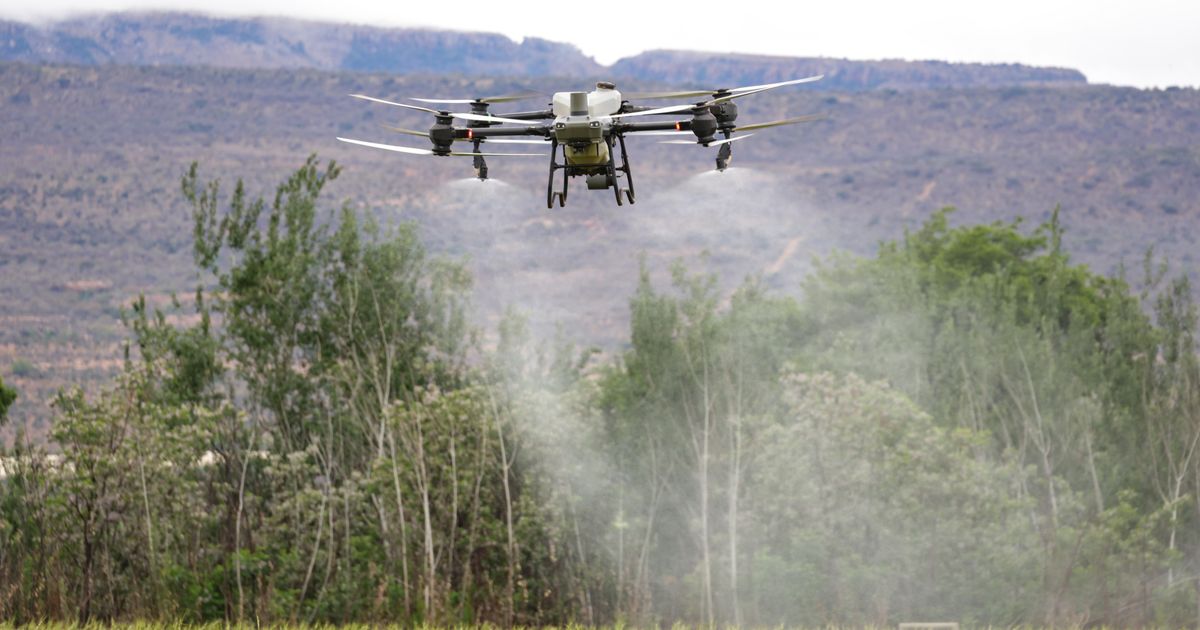
- Drones owned by a cooperative, service company or agricultural agency can map fields, estimate damage after a cyclone or check crops across many small farms in a day. Read our guide to farm drone survey costs.
- Simple sensors like the soil moisture tools in section 4 bring precision to a single plot for a few dollars.
2. Drought-tolerant and biotech crops
Crop scientists breed varieties that keep yielding through heat, drought, floods and pests, either through conventional breeding or genetic modification (GM) (GCA, USDA, CropLife).
Where Mozambique stands:
- Conventional drought-tolerant varieties of maize, sorghum, cassava and legumes are the most widely available tools today, and switching part of a farm from maize to drought-hardy crops like sorghum, cassava and pigeon pea is a proven way to spread risk.
- GM crops are still at the trial stage. Mozambique has had biosafety rules since 2007, updated in 2014, and since 2017 has run field trials of GM maize under the WEMA project, now called TELA maize, which showed resistance to stem borers and promising results against fall armyworm. TELA maize has not been commercialized in Mozambique (Genetic Literacy Project). Nigeria approved TELA maize for commercial planting in 2024 (Gazette Nigeria), so neighbors' decisions will shape Mozambique's.
More detail: GMO crops in Mozambique: TELA maize and drought-tolerant seed.
3. Smart irrigation and solar pumps
Most of Mozambique's farms rely on rain alone. Solar-powered pumps and drip irrigation change that: they use sunlight instead of diesel, deliver water to the root zone, and let farmers grow a second crop in the dry season. Mobile solar irrigation units, such as those made by Spowdi, are built for exactly this kind of farm (World Economic Forum).
What works in Mozambique: solar irrigation pays off near a reliable water source (a river, shallow well or borehole) and for crops that sell for cash, such as tomatoes, onions and leafy vegetables. The main barrier is the upfront cost, which is why pay-as-you-go plans and cooperative ownership matter. See irrigation for smallholders in Mozambique.
$25 plants a farmer's season in Zambézia.
Paid straight to the local seed shop. You get the receipt, a field photo and a harvest update.
A gift, not an investment. Not tax-deductible.
4. Soil moisture sensors: the cheapest precision tool
The best-documented success in Mozambique is also one of the simplest. In Gaza Province, farmers in the Rivoningo and Makateco irrigation schemes use low-cost Chameleon soil moisture sensors, which show soil dryness as a color, readable even by farmers who cannot read, and wetting front detectors, which show how deep water has soaked in.
The results, reported by Canada's International Development Research Centre (IDRC):
| Scheme | Before | After |
|---|---|---|
| Rivoningo (4 hectares) | Watered daily; about 34,900 meticais per season in irrigation costs | Watered twice a week; about 14,350 meticais per season (about 59% less) |
| Makateco | About 9,470 meticais per crop cycle | About 4,835 meticais (about half) |
Since 2020 the project has trained more than 400 farmers and 137 extension officers, and it is expanding to more schemes in Gaza and Manica provinces. Full story: how soil moisture sensors cut irrigation costs in Mozambique.
5. Livestock, methane and biogas
Cattle produce methane, a powerful greenhouse gas. Two technologies are changing that in rich countries: feed additives, such as the one developed by DSM, that can cut methane from cattle by up to about 30%, and biogas plants, such as those run by Brightmark in the United States, that turn manure into renewable natural gas (illuminem).
What works in Mozambique: feed additives depend on cattle eating a controlled ration every day, which suits feedlots and dairies rather than herds grazing on open range. Small biogas digesters are the more practical tool: they turn manure into cooking gas, which reduces tree cutting for firewood and charcoal, and leave a rich fertilizer. More: biogas and livestock methane in Mozambique.
6. Digital weather, early warnings and insurance
Smartphone and SMS services give farmers local forecasts, early warnings of storms and floods, advice on when to plant, and access to micro-insurance (FAO, GCA).
What works in Mozambique: mobile money is already widespread through M-Pesa, e-Mola and mKesh, so payments and alerts can reach farmers without a bank branch. Weather-index insurance, which pays out automatically when rainfall falls below a set level, can protect a season's investment, but it only works if farmers trust the payouts and the weather data near their fields is good. See weather insurance for Mozambican farmers and weather forecasting for farmers.
What about vertical farming?
Vertical farms grow crops in stacked indoor layers under LED lights, using hydroponics or aeroponics and a fraction of the land and water of field farming (Climatech). They make sense for high-value greens sold in cities, where electricity is reliable and buyers pay a premium. For Mozambique's staple crops like maize and cassava, the cost of power and equipment is far too high. Read vertical farming in Africa: does it make sense in Mozambique?
Low-tech practices that still do the heavy lifting
The most important climate-smart practices in Mozambique need no electronics at all:
- Conservation agriculture: minimal plowing, keeping crop residue on the soil and rotating cereals with legumes keeps moisture in the ground and soil on the field. Programs led by the international maize and wheat center CIMMYT have promoted it in Mozambique for years.
- Crop diversification: mixing drought-hardy crops with maize so one bad season does not wipe out the family's food.
- Agroforestry: trees in and around fields for shade, windbreaks, fruit and fodder.
- Better seed storage: hermetic bags and good drying cut post-harvest losses, which matters as much as yield.
Why this matters to Americans
- US agtech has a real market here. Sensors, solar pumps, drones, satellite analytics and insurance technology built for small farms in the US or elsewhere can find users in southern Africa, usually through local partners and cooperatives.
- It is where climate adaptation gets tested. What works for a 2-hectare farm in Gaza Province under drought and cyclones offers lessons for farmers everywhere facing more extreme weather.
- It shapes food prices and stability. Farming success in climate-exposed regions affects migration, food aid budgets and regional security.
Frequently asked questions
What is climate-smart agriculture?
Farming that raises productivity, helps farmers adapt to climate change, and reduces or stores greenhouse gases, all at the same time. The term is used by the World Bank, FAO and the UN climate convention.
What are examples of climate-smart agriculture technologies?
Precision agriculture (satellites, drones, sensors), drought-tolerant and biotech crops, solar and drip irrigation, soil moisture sensors, livestock methane reduction and biogas, digital weather and insurance services, and vertical farming.
Are GMO crops grown in Mozambique?
Not commercially. Mozambique has field-tested GM maize (TELA maize) since 2017 under its biosafety rules, but it has not been released to farmers.
Which climate-smart technology helps small farmers most?
The ones that are cheap and protect this season's harvest: drought-tolerant seed, low-cost soil moisture sensors, small solar irrigation near water, conservation agriculture and mobile weather alerts.
Sources
- World Bank: Climate-Smart Agriculture
- UNFCCC: Climate-smart agriculture
- CropLife: access to technologies
- TEKTELIC: smart agriculture solutions
- NSF: advancing farming with technology
- illuminem: climate-smart agriculture companies
- Global Center on Adaptation: technology helping farmers adapt
- USDA: biotechnology and climate change
- World Economic Forum: 12 climate-smart technologies
- FAO: science, technology and innovation in agriculture
- IDRC: Mozambique farmers produce more with less
- Genetic Literacy Project: Mozambique and GMO crops
About Maputo Bridge Capital
Maputo Bridge Capital connects Mozambican farmers with supporters in the United States, and publishes practical guides on farming, land and business in Mozambique. Meet the farmers.